How energy as a service (EaaS) works for UK businesses
Finance routeEnergy as a service (EaaS) is a contract under which a provider designs, pays for, installs, owns, runs and maintains energy equipment on your site, such as solar panels, batteries, LED lighting, heating and cooling or EV chargers, and your business pays a service fee instead of buying the kit. This guide explains how UK contracts are structured, how the fee is set and checked, the FRS 102 accounting from 2026, the tax, the rights a provider needs over your roof, and when buying or borrowing works out cheaper.
Quick answer
- Energy as a service (EaaS) is a contract under which a provider funds, installs, owns, runs and maintains energy equipment on your site, and you pay a service fee instead of buying it.
- Solar as a service is the solar-only version, and a per-kWh version works much like an on-site PPA.
- The fee can be fixed, per kWh, a share of measured savings, a guaranteed-savings deal or a mix; savings deals stand or fall on the M&V plan.
- From accounting periods beginning on or after 1 January 2026, FRS 102 puts a contract that contains a lease on the balance sheet; FRS 105 micro-entities are unaffected.
- The provider normally claims the capital allowances because it pays for the equipment, and a business customer can expect VAT on the fee at the standard 20% rate.
- Before signing, check the termination sums, what happens if you sell the building or the provider fails, and the end-of-term options.
What energy as a service means
Energy as a service (EaaS) is a way of getting energy equipment working on your site without buying it. A provider designs, pays for, installs, owns, operates and maintains the assets, and your business pays a service fee for the result under a long contract. The assets can be solar panels, battery storage, LED lighting, heating, ventilation and air-conditioning plant, EV charging, building controls or a mix of them. The provider carries the capital cost and the job of keeping the kit running; you get the electricity, light, heat or charging, and you pay for that rather than for the equipment.
The label is a commercial one, and two offers sold as energy as a service can be very different contracts. The useful questions are always the same: who owns the equipment, what exactly the fee pays for, what happens if the kit underperforms, and how the contract ends. This guide works through those questions for UK offers: how a contract is put together, how the fee is set, how savings are measured, how the contract is accounted for under FRS 102 from 2026, the tax, the rights a provider needs over your roof, the risks to check, and when buying or borrowing works out cheaper.
Solar as a service
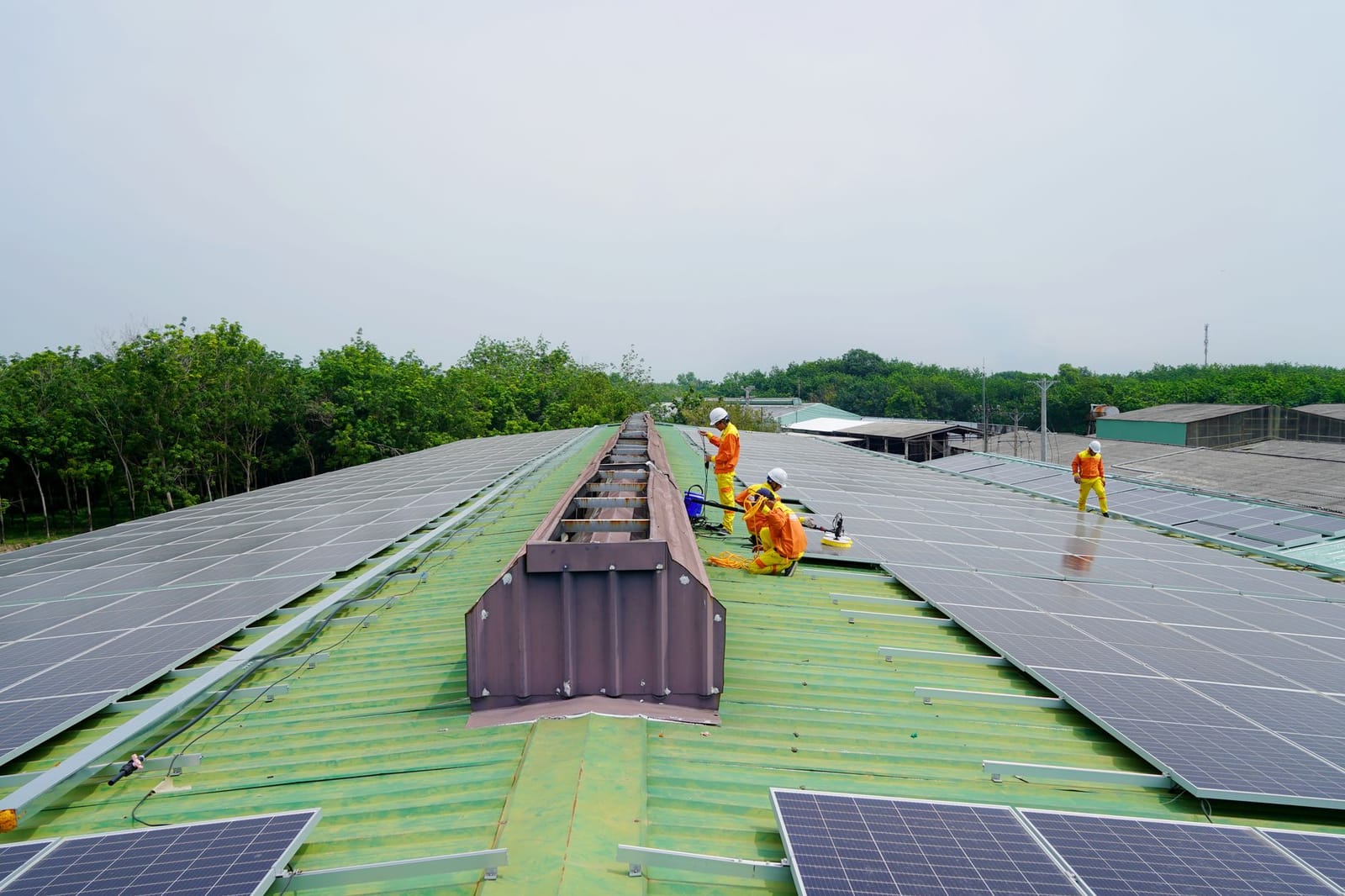
Solar as a service is the solar-only version. A provider puts an array on your roof or land, owns and maintains it, and charges you either a fixed fee or a price for each unit of electricity you use from it. When the charge is per kilowatt hour (kWh), the arrangement works much like an on-site power purchase agreement; the difference lies mainly in the label and in what else is bundled with the panels, such as batteries, monitoring or EV chargers.
Energy service companies (ESCOs) and energy performance contracts
An energy service company, usually shortened to ESCO, is a business that delivers energy services or efficiency measures at a customer's premises. The EU's 2012 Energy Efficiency Directive (2012/27/EU), which legislation.gov.uk publishes, calls this an energy service provider: a person who delivers energy services or other energy efficiency improvement measures in a final customer's facility or premises. It defines an energy service as the benefit derived from combining energy with energy-efficient technology or with action, which may include the operations, maintenance and control needed to deliver the service, delivered on the basis of a contract and normally resulting in verifiable and measurable or estimable efficiency improvements or energy savings.
The classic ESCO product is the energy performance contract. The same directive describes it as an arrangement between the beneficiary and the provider of an efficiency measure, verified and monitored during the whole term of the contract, in which the investment is paid for in relation to a contractually agreed level of energy efficiency improvement or another agreed performance criterion, such as financial savings. Some energy as a service offers include a guaranteed-savings or shared-savings element of this kind. Others simply charge a fee for the equipment and the service, with no link to measured savings at all.
How it differs from the other ways to pay
The routes overlap, so it helps to line them up by who owns the equipment and what you pay for.
| Route | Who owns the equipment | What you pay for |
|---|---|---|
| Energy as a service | The provider, for the whole term, unless you buy it at the end | A service fee: fixed, per unit, linked to savings, or a mix |
| On-site power purchase agreement (PPA) | The provider or its funder | Each kWh the system delivers to you, at an agreed price |
| Operating lease | The lessor; you rent the equipment | Rent for the use of the equipment for the lease period |
| Hire purchase or a loan | You: once a hire purchase agreement is paid off, or from the start with a loan | Repayments of the cost plus interest |
| Energy performance contract (ESCO) | Varies: the provider may fund and own the works, or you may | Works paid for in relation to an agreed level of savings |
The detail of each alternative is on the operating lease, hire purchase and business solar loan pages, and finance options compared sets every route side by side.
How an energy as a service contract is put together
An energy as a service deal is rarely one document. Expect a bundle that can include:
- The service agreement. It lists the assets and the services (design, installation, operation, maintenance, monitoring and replacements), the fee and how it changes, any performance guarantee, the term, the termination rights and sums, and the end-of-term options.
- A property document. A lease or a licence of the roof or land, giving the provider the right to install, keep, reach, maintain, replace and eventually remove its equipment for the whole term.
- A power or metering schedule where the fee is charged per kWh: which meter measures it, how units are read and billed, and what happens to electricity you cannot use.
- Consents and side letters. From your landlord if you rent the building, from your mortgage lender if the property is charged, and sometimes a direct agreement between you and the provider's funder.
What is bundled varies from offer to offer, so make the provider list it in writing. The items that matter most are operation and maintenance, remote monitoring, insurance of the equipment, replacement of parts that wear out within the term (for solar, the inverters are the obvious example), and any guarantee of output or savings with the remedy if it is missed. Anything the contract leaves out is likely to fall to you.
How the energy as a service fee is set
There is no standard price list. Offers are priced site by site, and the structures below can be combined. For each one, the questions that follow are the ones that decide what you actually pay.
A fixed periodic fee
You pay the same amount each month or quarter, which may rise each year by an index or a fixed percentage, whatever the equipment produces or saves. It is easy to budget, but the risk of underperformance sits with you unless the contract adds an output or savings guarantee. Ask how the fee escalates, exactly what it covers, and what you receive if the equipment is out of action.
A charge per unit (kWh)
You pay an agreed price for each kWh the system delivers and you use, so you pay nothing for units it does not produce. Ask how the price is indexed, whether there is a minimum annual payment, how electricity you cannot use is treated (exported, stored or paid for anyway), who keeps any export income such as Smart Export Guarantee payments, and whether you are charged for deemed output when the system is switched off at your request, for example during roof repairs.
Shared savings
The fee is a share of the savings measured against an agreed baseline. The provider earns more when the project saves more, which lines up incentives, but the result depends entirely on how the baseline is set and adjusted. That is a measurement question, covered in the next section.
Guaranteed savings
The provider promises a level of savings and pays you the shortfall if measured savings fall below it. A guarantee is only as good as its wording, its measurement method, its cap and the provider's ability to pay, so read all four before relying on it.
Hybrids
An offer can mix these: a fixed fee for the equipment with a per-unit charge for the power, or a fixed fee with an annual true-up against measured savings. Ask for a worked example of the fee in a good year and a bad year, using the contract's own formula.
The structure also changes the accounting. If the contract contains a lease, fixed payments, including payments that look variable but cannot in substance be avoided, are measured into the lease liability, while variable payments that do not depend on an index or a rate are charged to profit or loss as they arise. A pure per-kWh charge and a fixed monthly fee for the same array can therefore look very different on the balance sheet, as the accounting section below explains.
Measuring savings: baselines and IPMVP
For a shared-savings or guaranteed-savings contract, the measurement method effectively is the contract. The usual reference is the International Performance Measurement and Verification Protocol (IPMVP), which is owned and maintained by the Efficiency Valuation Organization (EVO), a non-profit organisation. EVO says the protocol was adopted broadly by energy services companies first and is now also used by utilities and government agencies, and that financial institutions increasingly treat it as a risk-reduction framework for their investments. It describes measurement and verification (M&V) as fundamental to energy performance contracting and to energy efficiency financing.
The starting point is that energy savings cannot be directly measured, because a saving is the absence of consumption. Instead, savings are worked out by measuring energy use before and after a project within a defined measurement boundary, making suitable adjustments for changes in conditions. IPMVP is primarily a non-prescriptive framework: each project's method is designed for that project and recorded in its M&V plan, and savings are then reported as the plan defines them. The protocol describes four options:
- Options A and B, retrofit isolation: a measurement boundary is drawn around the equipment the project changed, such as a lighting circuit or a chiller, and its energy use is measured.
- Option C, whole facility: the meters that measure the supply to the whole site are used, which suits projects with several measures that affect each other.
- Option D, calibrated simulation: a calibrated model is used where baseline or reporting-period data are unreliable or unavailable, as in new construction.
EVO notes that with on-site solar generation, energy can flow in reverse across the measurement boundary, which is why the M&V plan has to say how exported units are counted. Before signing, make sure the plan answers these questions in writing:
- Which period sets the baseline, and was it a normal period of operation?
- Which changes trigger an adjustment: weather (heating and cooling degree days), production volumes, opening hours, floor area or occupancy?
- Where is the measurement boundary, which meters are used, and who owns and reads them?
- Are savings counted in kWh and converted to money at a contract price, or valued at your actual tariff?
- Who prepares the savings report, how often, and can you appoint an independent reviewer?
- How are disputes resolved, and what happens to the fee while one is open?
An illustrative example shows why the adjustment rules matter. The numbers are invented round figures chosen only to show the arithmetic; they are not market rates, typical terms or a recommended split.
| Illustrative input or result | Value |
|---|---|
| Baseline-year electricity use (input) | 400,000 kWh |
| Reporting-year use after the project (input) | 330,000 kWh |
| Adjusted baseline: production rose, and the plan's formula says the site would have used this much without the project (input) | 420,000 kWh |
| Contract value of each kWh saved (input) | 20p |
| Provider's share of savings (input) | 50% |
| Unadjusted saving: 400,000 minus 330,000 | 70,000 kWh, worth £14,000 |
| Adjusted saving: 420,000 minus 330,000 | 90,000 kWh, worth £18,000 |
| Provider's fee at 50% | £7,000 unadjusted, or £9,000 adjusted |
The same project is worth £14,000 or £18,000 depending on one adjustment, and the fee moves by £2,000. That is why the baseline and the adjustment formula deserve more attention than the headline share.
Energy as a service on the balance sheet: FRS 102 from 2026
If an energy as a service offer is pitched as off balance sheet, check the date on that advice. The Financial Reporting Council (FRC) completely rewrote Section 20 Leases of FRS 102 in its Periodic Review 2024, with the changes effective from 1 January 2026; most of the amendments apply to accounting periods beginning on or after that date, and early adoption was permitted. Based on the principles of IFRS 16 Leases, the new section removes the distinction between operating and finance leases for lessees, so more leases now bring a right-of-use asset and a lease liability onto the balance sheet. It applies to every entity using FRS 102, including small entities reporting under Section 1A. There is a fuller walk-through in is energy as a service on or off the balance sheet?
Does the contract contain a lease?
A contract does not need to be called a lease to be one. FRS 102 asks whether it conveys the right to control the use of an identified asset for a period of time in exchange for consideration, and the FRC points out that a contract can meet that definition in substance even if it lacks the legal form of a lease and does not explicitly specify the asset. For an energy as a service contract the test comes down to three questions:
- Is there an identified asset? An array on your roof is normally specified, either in the contract or by being the one installed. But there is no identified asset if the supplier has a substantive right to substitute it throughout the period of use, which means having the practical ability to swap in other assets and an economic benefit from doing so. A share of a larger system that is not physically distinct is not an identified asset unless it is substantially all of the capacity.
- Do you obtain substantially all the economic benefits from its use? The benefits include the asset's primary output and its by-products. If you take all the electricity from an array on your site, this condition may well be met; if the provider exports or sells a large part of the output elsewhere, it may not be.
- Do you have the right to direct its use? Either you direct how and for what purpose the asset is used, or those decisions are predetermined and you either operate the asset or designed it in a way that predetermines its use. A solar array's use is largely fixed by the sun, so the answer can turn on who operates the equipment and who designed it. That is exactly where energy as a service contracts, with the provider designing, operating and maintaining the kit, need careful reading.
If the answer to any of the three is no, there is no lease and Section 20 does not apply to the contract. If all three are yes, the lease part is accounted for under Section 20. The assessment is made at the start of the contract and revisited only if its terms change, so settle it with your auditor before you sign rather than at the first year end.
What goes on the balance sheet
Where there is a lease, you recognise a right-of-use asset and a lease liability. The liability is the present value of the lease payments, which include:
- fixed payments, including in-substance fixed payments that may look variable but cannot in substance be avoided;
- variable payments that depend on an index or a rate, measured using the index or rate at the commencement date;
- amounts you expect to pay under any residual value guarantee;
- the price of a purchase option you are reasonably certain to exercise; and
- penalties for terminating, if the lease term assumes you will terminate.
Variable payments that do not depend on an index or rate are left out of the liability and charged to profit or loss when they arise. The FRC's own example is a turnover rent. A charge per kWh generated is also variable and not linked to an index or rate, so a contract priced purely per unit may carry only a small lease liability even where the asset is identified, while a fixed monthly fee for the same array would put most of the payments on the balance sheet. The lease term is the non-cancellable period plus any extension you are reasonably certain to take, and the cost of the right-of-use asset includes any recognised estimate of the cost of dismantling and removing the asset, which matters if the contract makes you pay for removal at the end.
Service components and exemptions
An energy as a service fee pays for more than the use of the equipment. Section 20 accounts for the lease component separately from non-lease components such as maintenance, splitting the consideration by relative stand-alone prices, unless the lessee elects, by class of underlying asset, to use a practical expedient and treat them as one lease component. Separating them keeps the maintenance, monitoring and other service elements out of the lease liability, so ask the provider to price the elements separately.
Two recognition exemptions remain. A short-term lease, with a lease term of 12 months or less and no purchase option, can stay off the balance sheet; a multi-year contract will only fit if, in substance, either side can walk away within the year with no more than an insignificant penalty. Leases of low-value assets can stay off too, but Section 20 sets no value threshold. The FRC's examples are tablets and personal computers, small items of office furniture and telephones, and a lease cannot be kept off the balance sheet by breaking an asset down into low-value components. A roof-scale array or a battery system is unlikely to qualify.
Who else is affected
- Micro-entities using FRS 105: the FRC made no equivalent change to FRS 105, so the lease accounting it already required continues.
- Groups and companies reporting under IFRS: IFRS 16 replaced IAS 17 for accounting periods beginning on or after 1 January 2019, and the revised FRS 102 follows its principles, so the same questions apply.
- The provider: accounting by lessors remains largely unchanged, and the operating and finance lease distinction stays in place for them.
What it does to your numbers
For a company that brings a contract onto its balance sheet, the FRC expects users of the accounts to see higher assets and liabilities, lower rental expense, higher depreciation and interest, and the principal part of payments shown as financing cash flows. Interest is typically front-loaded, so the liability usually exceeds the asset during the life of the lease even though the cash paid is unchanged. The FRC warns that gearing, interest cover, current ratio and EBITDA may change, with implications for loan covenant compliance, and that some entities may want to renegotiate covenants. Before you sign, ask your lender how it will treat the new liability in its covenant tests, whether your facility measures covenants on the accounting standards in force when it was signed, and whether it needs to consent to the contract at all. On first application the cumulative effect goes to equity and comparatives are not restated.
Tax: who claims the allowances, and what you pay
Capital allowances stay with the provider
The tax follows ownership more than the label. HMRC's leasing manual says that, generally, capital allowances are given to the legal owner of an asset, whether a lease is a finance lease or an operating lease, with special rules for hire purchase and for fixtures. Solar panels are on HMRC's list of items normally regarded as fixtures, and a fixture is an asset fixed to a building or land so as to become part of it in law. In law a fixture belongs to the freeholder, so the fixtures rules in Chapter 14 of Part 2 of the Capital Allowances Act 2001 decide who is treated as the owner. They treat a person who incurs capital expenditure on a fixture as its owner, while making sure allowances do not go to more than one person at the same time.
Under energy as a service the provider pays for the equipment. A provider that incurs the expenditure for its own qualifying activity, and has an interest in the land when the equipment becomes a fixture, such as a lease of your roof or a licence to occupy it, is treated as the owner of the fixture under section 176; the section's own tie-break rules expressly treat a licence to occupy land as such an interest. Where the equipment is instead leased to you and the statutory conditions are met, the provider (as equipment lessor) and your business (as equipment lessee) can jointly elect under section 177 for the provider to be treated as the owner, provided you are not connected persons. Once that election is made, you cannot be treated as the owner under section 176. For corporation tax the election must be made no later than two years after the end of the chargeable period in which the expenditure was incurred. Either way, only one party gets the allowances, and under energy as a service it is normally the provider, because the provider pays for the equipment. For the rules when your business owns the panels, see capital allowances on solar panels and solar panel tax relief.
Your fee, and the long funding lease test
Your side is simpler. HMRC says lease rentals are revenue expenditure regardless of the accounting treatment, unless there are exceptional circumstances, and the FRS 102 changes were not meant to alter that: legislation in Schedule 14 to the Finance Act 2019 aimed to ensure that new or revised accounting standards did not change the tax treatment of lessees. In most cases the deduction for a lease on the balance sheet equals the depreciation and interest charged in the accounts. If the contract contains no lease at all, the fee is a payment for a service and the usual rules for business expenses apply; your accountant can confirm the treatment.
One test still needs running. If a contract is a lease of plant for tax purposes, it has to be checked against the long funding lease rules, because under a long funding lease the lessor loses the right to claim capital allowances and the lessee generally gains it. Length is one of the tests: for these rules a lease whose term is 7 years or less is a short lease, although the finance lease in a sale and finance leaseback is never a short lease whatever its length, and HMRC's manual taxes a lease that does not meet the long funding lease tests as any other trading expense. If the contract runs for more than seven years, ask the provider which tax analysis its pricing assumes. That seven-year line is separate from the seven-year registration rule for roof leases described below.
VAT on the fee
The standard rate of VAT is 20%, and that is the rate to expect on an energy as a service fee charged to a business. Where the fee is a charge for electricity supplied, HMRC's fuel and power notice applies: supplies of fuel and power are standard-rated unless they qualify for the reduced rate, and the reduced rate is for qualifying use, meaning domestic use or a charity's non-business use. The temporary zero rate that runs in Great Britain from 1 October 2026 to 31 March 2027 is for qualifying supplies only, so it does not cover electricity a business uses for its trade. Whether you can reclaim the VAT depends on your own VAT position; see VAT reclaim on commercial solar.
Climate Change Levy on the power
The main rates of Climate Change Levy (CCL) are payable on electricity and other energy supplied to businesses and public sector organisations, and the main rate on electricity is £0.00801 per kWh for supplies from 1 April 2026. HMRC's Excise Notice CCL1/3, updated on 24 March 2026, treats photovoltaics as a source of renewable electricity and says an auto-generator or exempt unlicensed supplier does not need to account for CCL on self or direct supplies of renewable source electricity. A direct supply is one made under a contract involving only the renewable generator and the customer, with no intermediary third party taking ownership of the electricity. Renewable electricity supplied by a utility, or by any other third party, is a taxable supply. So solar power sold to you directly by the provider that owns the array can carry no CCL, while the same power routed through a supplier does. Ask the provider how its supply is structured, and remember that the grid electricity you still buy carries CCL as before.
Business rates on the plant
Temporary rating exceptions currently leave renewable generation and storage plant out of the plant and machinery assumed to be part of a property's rateable value. In England, regulations in force from 1 April 2022 take plant and machinery used, or intended to be used, for generating, storing, transforming or transmitting power mainly from listed renewable sources, photovoltaics included, out of that assumption for any day before 1 April 2035. Wales has an equivalent exception for days on or after 1 April 2024 and before 1 April 2035, and Scotland for days from 1 April 2023 to 31 March 2035. The exceptions say what is left out of a property's valuation; they do not settle how an array owned by someone else on your roof is treated, which turns on the facts. Do not assume a provider-owned array is automatically exempt or automatically rated separately: ask the provider how its arrays have been treated elsewhere and who pays if a rates bill arrives. More on the business rates exemption.
The rights a provider needs over your roof or land
A provider that owns equipment fixed to your building needs documented rights for the whole contract term: to install the equipment, keep it there, reach it, maintain and replace it, run cables to the point of connection and, at the end, remove it. It will also want to stop anything that would cut output, such as new structures that shade the array. Those rights usually sit in a lease of the roof space or land, or in a licence, alongside the service agreement. See renting out a roof for solar panels and commercial solar roof lease terms for the clauses.
Registering a roof lease
HM Land Registry's guidance, which applies to England and Wales, says a new lease granted for a term of more than seven years is compulsorily registrable, whether it is granted out of a registered title or out of unregistered land. Where the land is unregistered, the period for applying is two months from the date of the deed that triggers registration. A roof lease that runs for more than seven years therefore has to be registered. In Scotland and Northern Ireland, take local advice.
If you rent the building
The roof may not be part of what is let to you, and your lease may restrict alterations, so involve the landlord from the start. Where a lease requires the landlord's consent for improvements, section 19(2) of the Landlord and Tenant Act 1927 says that consent is not to be unreasonably withheld, although the landlord can ask for a reasonable sum for any damage to or loss in value of its property and for its expenses, and, for an improvement that does not add to the letting value, a reasonable undertaking to reinstate the premises. Section 19 applies in England and Wales and not to agricultural holdings or farm business tenancies. Also check that the energy contract's term does not outlast your own lease, and read green leases and can a tenant install solar panels before you approach the landlord.
Lenders and other consents
If the property is mortgaged, check whether the mortgage or facility agreement restricts granting leases or other rights over it, because the provider's roof lease or licence may need your lender's consent. The provider's own funder may also ask you to sign a direct agreement that lets it step in if the provider fails.
Risks to check before you sign
- Term and early termination. How long is the minimum term, can you end it early, and what is the termination sum in each year? Ask for the formula and a year-by-year schedule, and check whether it covers only the provider's unrecovered investment or its lost future profit as well.
- Selling, moving or re-letting the building. Can the contract be transferred to a buyer or a new occupier, does the provider have to consent, and what happens if the buyer refuses to take it on?
- Provider insolvency. Who owns the equipment if the provider fails, can its funder step in and keep the service running, and are your payment obligations tied to the service actually being delivered? Ask whether the provider can assign the contract to a funder or a buyer, and on what terms.
- Performance shortfalls. What is guaranteed (availability, output or savings), how is it measured, what is the remedy (a fee reduction or a payment), and is the remedy capped?
- Roof works and downtime. Who pays to lift and refit panels for roof repairs, and are you charged for deemed output while the system is off?
- Insurance. Who insures the equipment, who insures the building beneath it, and has your buildings insurer been told?
- End of term. Can you buy the equipment at a fixed price or at market value, renew the contract, or have the equipment removed at the provider's cost with the roof made good? A purchase option you are reasonably certain to exercise also changes the lease liability.
- Data. Do you get the monitoring data and meter readings during and after the contract, in a format you can use for your own energy and carbon reporting?
When energy as a service makes sense, and when buying or borrowing is cheaper
A provider has to recover the cost of the equipment, its finance, its operation and its risk from your fee, and earn a return on top. An owner keeps all of the savings once the equipment and any borrowing are paid for. So on the same assumptions, owning leaves more of the savings with you over the life of the equipment, provided you can fund it and use the tax relief, while energy as a service buys you no capital outlay, someone else carrying the operating risk, and one counterparty for several technologies. The table sets out where each route tends to fit. It contains no prices, because offers are priced site by site.
| Your situation | Leans towards | Why |
|---|---|---|
| You have cash or affordable borrowing, pay tax and can use the allowances | Buying outright or with a loan | You keep all the savings and, as owner, can claim the capital allowances |
| Capital is better used elsewhere, or credit lines are full | Energy as a service or a PPA | The provider funds the equipment and you pay as you benefit |
| You want several technologies (solar, batteries, LED, HVAC, EV charging) delivered and run as one project | Energy as a service | One counterparty, one contract, one set of service levels |
| You only want solar and are content to pay per unit used | A PPA | Simpler than a bundled service, with no charge for units not delivered |
| You want to own the equipment at the end | Asset finance or hire purchase | Ownership is the end point, not an option to negotiate |
| You may sell or move within the likely term | Buying, or a contract with clear transfer terms | Termination sums can make an early exit expensive |
| Your roof needs work in the next few years | Repair the roof first | Lifting and refitting panels mid-contract costs money and output |
| You rent the building on a lease shorter than the contract | Talk to your landlord first | The provider needs rights for the whole term |
| You report under FRS 102 and your gearing covenants are tight | Settle the accounting before choosing | A contract that contains a lease adds a lease liability |
To test the routes on your own figures, use the finance calculator and the payback and ROI guide; asset finance and no upfront cost options cover the other ways to avoid a large capital outlay.
Energy as a service companies: checking the provider
Energy as a service is offered under several names, so start from what the provider's own material says it delivers. The names differ (energy as a service, solar as a service, a funded or subscription model, an energy performance contract), so compare offers on what each contract actually commits the provider to deliver and what it commits you to pay. This guide does not rank or recommend providers.
Whoever the provider is, the contract will run for years, so check the company as well as the offer:
- Which company will own the equipment and sign the contract, and is that a funding vehicle backed by investors rather than the firm you have been talking to?
- What do its filed accounts show about its size and financial strength, given that it has to keep servicing the equipment for the whole term?
- Who will install and maintain the equipment, its own staff or subcontractors, and what certifications do they hold?
- Will it share its standard contract, termination schedule and M&V plan before you negotiate, and let you contact existing customers you choose?
- What happens to your contract if it sells its portfolio of contracts to another owner?
Before you sign
This guide is general information, not tax, accounting or legal advice. The lease assessment, the capital allowances position and the property documents all turn on the exact wording of the contract, so check your own position with your accountant or auditor, a solicitor and, where relevant, HMRC before you commit. Once you know which route suits you, you can request a quote for the equipment itself and compare it against any energy as a service offer on the same assumptions.
How to assess an energy as a service offer
- 1Define the scope and the baseline. List the equipment you want covered and gather at least a year of meter data, so any savings baseline reflects normal operation of the site.
- 2Get the whole contract bundle. Ask for the service agreement, the roof lease or licence, the fee schedule and its indexation, the termination schedule and any M&V plan before you negotiate.
- 3Test the accounting with your auditor. Decide whether the contract contains a lease, which payments are fixed or index-linked, and how the service elements are priced, so you know what goes on the balance sheet.
- 4Check the tax and the property rights. Confirm who claims the capital allowances, the VAT and CCL position, any landlord and lender consents, and whether a roof lease of more than seven years needs registering.
- 5Compare it with the alternatives. Model the whole-life cost against buying, a loan, hire purchase, an operating lease and a PPA, using the same output and price assumptions for each.
- 6Negotiate the exits. Agree what happens on a sale of the building, on provider insolvency, during roof repairs and at the end of the term, including buy-out, renewal and removal.
Watch-outs before you rely on it
- Energy as a service means a provider funds, owns and runs energy equipment on your site for a service fee; solar as a service is the solar-only version.
- Fees can be fixed, per kWh, shared or guaranteed savings, or a mix, and savings-based fees depend on the M&V plan, which is usually built on IPMVP.
- Under FRS 102, for periods beginning on or after 1 January 2026, a contract that contains a lease goes on the balance sheet; FRS 105 micro-entities are unaffected.
- Solar panels are normally fixtures, so the fixtures rules decide who claims the capital allowances, and under energy as a service that is normally the provider.
- Solar power supplied directly by an exempt unlicensed supplier carries no CCL, but a business can expect VAT at the standard 20% rate on the fee.
- In England and Wales a roof lease of more than seven years must be registered at HM Land Registry, and tenants need to involve the landlord.
Compare the routes before you commit. See every funding route side by side, model the numbers in the finance calculator, or request a costed quote for your building.
Sources
- FRC: FRS 102 Factsheet 11, Lease accounting for lessees (November 2024), PDF
- FRC: FRS 102 Explainer, Periodic Review 2024 changes for users (June 2026), PDF
- FRC: Periodic Review 2024, key changes, PDF
- Efficiency Valuation Organization: International Performance Measurement and Verification Protocol (IPMVP)
- HMRC Capital Allowances Manual CA26025: fixtures, background and meaning of fixture
- Capital Allowances Act 2001, section 176
- Capital Allowances Act 2001, section 177
- HMRC Business Leasing Manual BLM00075: leasing and capital allowances
- HMRC Business Leasing Manual BLM50005: taxation of right-of-use asset lessees
- HMRC Business Leasing Manual BLM51005: taxation of short leases held by right-of-use lessees
- Capital Allowances Act 2001, section 70I (short lease)
- Directive 2012/27/EU on energy efficiency, article 2 (definitions), legislation.gov.uk
- GOV.UK: VAT rates
- HMRC VAT Notice 701/19: fuel and power
- HMRC Excise Notice CCL1/3: Climate Change Levy reliefs and special treatments (updated 24 March 2026)
- HMRC: Climate Change Levy, changes to rates from 1 April 2026
- Valuation for Rating (Plant and Machinery) (England) (Amendment) Regulations 2022, S.I. 2022/405
- Valuation for Rating (Plant and Machinery) (Wales) (Amendment) Regulations 2023, W.S.I. 2023/1229
- Valuation for Rating (Plant and Machinery) (Scotland) Amendment Regulations 2023, S.S.I. 2023/32
- HM Land Registry Practice Guide 25: leases, when to register
- Landlord and Tenant Act 1927, section 19